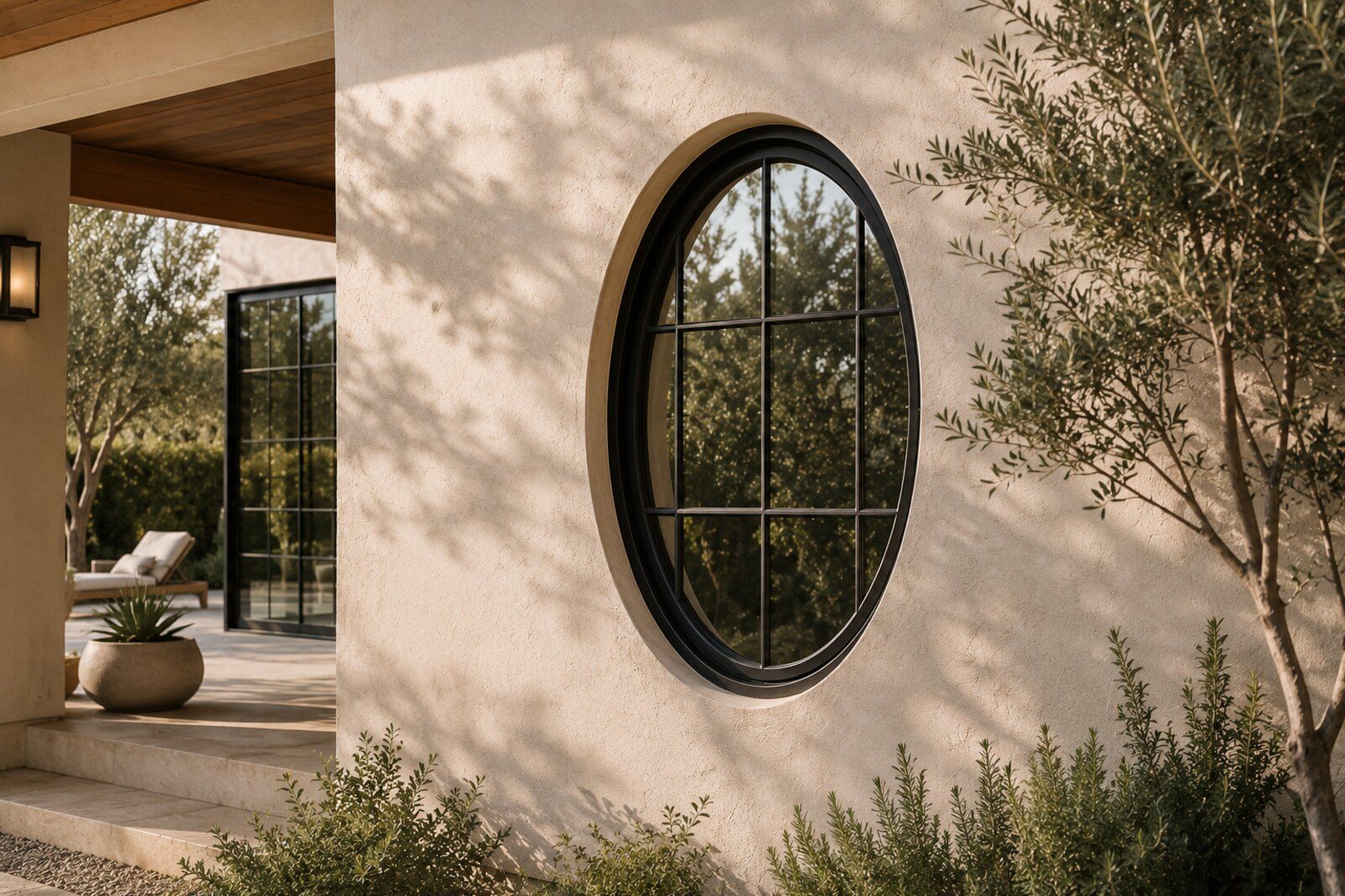
This page is reference, not a product claim. Crateworks confirms in writing which certifications and test reports apply to a given order before production. Coverage varies by configuration and jurisdiction.
Contents
- ·NFRC ratings, U-factor, SHGC, VT
- ·AAMA finish grades 2603, 2604, 2605
- ·Florida Product Approval and Miami-Dade NOA
- ·NAFS / AAMA-WDMA-CSA 101 for North American fenestration
- ·CSI 3-part specification format
- ·IECC climate zones and U-factor targets
- ·Samples, profile cuts, and IGU swatches
- ·Glass selection: pane count, coating, gas fill
- ·Hardware: multi-point locks, hinges, finish
- ·Acoustic spec: STC, OITC, IGU configurations
- ·Install drawings: rough opening, sill pan, flashing
- ·Project workflow: DD through punch list
NFRC ratings, U-factor, SHGC, VT
The NFRC (National Fenestration Rating Council) label on a finished window reports four numbers: U-factor (heat transfer through the assembly, lower is better), SHGC (solar heat gain coefficient, how much solar energy passes through, lower reduces cooling load), VT (visible transmittance, daylight as a fraction of incident light), and AL (air leakage). NFRC ratings cover the whole product, frame and glass together, not just the IGU. Energy codes in most US jurisdictions are written against NFRC numbers, so the U-factor on the label is what gets compared to the IECC climate-zone requirement on the permit set. Crateworks provides NFRC documentation per order when the spec calls for it.
AAMA finish grades 2603, 2604, 2605
AAMA 2603, 2604, and 2605 are the three voluntary finish-performance standards for organic coatings on architectural aluminum extrusions. 2603 is the entry tier and is appropriate for interior or sheltered applications. 2604 is the commercial mid-tier with a five-year exterior weathering requirement. 2605 is the top tier with a ten-year exterior weathering requirement and is what most coastal, high-rise, and premium-spec exterior projects call for. Crateworks aluminum finishes can be specified to any of the three tiers; finish tier is called out on the quote and confirmed on the order.
Florida Product Approval and Miami-Dade NOA
Florida operates two parallel approval systems for fenestration. Statewide Florida Product Approval (FL#) is issued by the Florida Building Commission and is required for all wind-borne-debris-region projects. Miami-Dade County issues its own Notice of Acceptance (NOA) for the High-Velocity Hurricane Zone (HVHZ) covering Miami-Dade and Broward counties; an NOA is required there in addition to or in place of a state FL number. Both systems require third-party impact and structural testing at specified design pressures. Crateworks confirms in writing which approval pathway applies to a given project before order; we do not market HVHZ-rated product without the corresponding NOA on file.
NAFS / AAMA-WDMA-CSA 101 for North American fenestration
NAFS (North American Fenestration Standard, AAMA/WDMA/CSA 101) sets a unified performance rating across the US and Canada. The Performance Grade (PG) number combines design pressure, water resistance, and other structural requirements. NAFS is referenced in both the IBC and the Canadian National Building Code, so a NAFS-tested unit can move across the border on the same test report. Crateworks specifies NAFS-listed product where the spec calls for it; the PG required for a project depends on building height, exposure, and jurisdiction.
CSI 3-part specification format
Crateworks aluminum windows fall under CSI Division 08 41 13 (Aluminum-Framed Entrances and Storefronts) for storefront/curtain-wall configurations and 08 51 13 (Aluminum Windows) for residential and commercial window assemblies. Interior aluminum and glass doors fall under 08 14 16 or 08 80 00 depending on the assembly. We can provide a 3-part spec section (Part 1 General, Part 2 Products, Part 3 Execution) tailored to a specific project for inclusion in the project manual. Request the spec section through the trade program.
IECC climate zones and U-factor targets
The International Energy Conservation Code (IECC) divides North America into climate zones 1 through 8. The prescriptive U-factor requirement for fenestration tightens as the climate gets colder: zone 1 (south Florida) allows roughly 1.20, zone 4 (Mid-Atlantic) lands near 0.32, zone 6 (northern US) near 0.30, zone 7-8 (Alaska, northern Canada) lower. The exact threshold depends on the code edition the jurisdiction has adopted. A thermally-broken aluminum frame paired with a triple-pane IGU can typically meet zone 4 to 6 targets; zone 7 to 8 may require a higher-performance IGU and a tighter frame thermal break.
Samples, profile cuts, and IGU swatches
We ship a physical sample kit on request that includes profile cross-section cuts, IGU thickness samples, finish chips in your specified RAL number or AAMA finish tier, and reference examples of how NFRC and NAFS labels are formatted on equivalent product classes. Product-specific NFRC and NAFS certification is confirmed in writing per SKU before any order. The kit is part of the trade program; partners running active spec projects receive priority on samples.
Glass selection: pane count, coating, gas fill
Glass spec covers four variables. Pane count: double-pane (DGU) for temperate climates, triple-pane for climate zone 5 and colder. Low-E coating: soft-coat (sputtered, emissivity around 0.04) for new construction, hard-coat (pyrolytic, emissivity around 0.15) for storm windows or surfaces that need durability. Gas fill: argon is standard, krypton in tight cavities for premium triple-pane. Safety class: tempered required by code for doors, sidelights, and low glazing; laminated for impact-rated or sound-rated assemblies. Crateworks confirms IGU build (pane thickness, coating position, gas, spacer) on the quote per opening; specifying a configuration that exceeds project performance targets without cost reason is the most common over-spec we flag back.
Hardware: multi-point locks, hinges, finish
Hardware decisions sit alongside the glass. Locks: multi-point standard on exterior tilt-turn, bifold, and lift-slide; single-point standard on entry doors with deadbolt augmentation. Hinges: concealed for slim-sightline aesthetic, surface-mounted for serviceability. Finish: brass, chrome, satin nickel, matte black; selected to match interior hardware suite. Operating force: AAMA recommends maximum 5 lbf on residential window hardware; tilt-turn and large sliding panels can exceed this without compensating hardware, which we flag and re-spec. Cylinder system on entry doors: residential SC1/KW1 standard; commercial Schlage C or restricted-key system on request. Hardware brand selections stay off the spec sheet by request and remain supplied with the unit; the quote calls out the function (e.g., 'concealed multi-point lock with thumb-turn deadbolt') without naming the manufacturer.
Acoustic spec: STC, OITC, IGU configurations
Acoustic spec runs through the IGU. STC 28 to 32 is the single-pane and basic double-pane baseline. STC 40 to 45 is reachable with asymmetric-thickness IGU (e.g., 4mm + 6mm panes) and double-pane construction. STC 48+ requires laminated glass with PVB or acoustic-PVB interlayer on at least one lite of the IGU. OITC (Outdoor-Indoor Transmission Class) weights low-frequency content (traffic, aircraft) more heavily and is the better predictor for road-facing or flight-path projects. Title 24 California acoustical standards apply at 65 dBA exterior noise contour; specify STC 30 minimum, STC 40+ for high-exposure facades. Acoustic spec usually pairs with multi-point lock and continuous perimeter gasket to seal the assembly to the acoustic rating.
Install drawings: rough opening, sill pan, flashing
Install detail is half of how the window performs in the wall. Rough opening typically built 1/2 inch over each window dimension to allow shimming and sealing. Sill pan required for code-compliant install in most jurisdictions; can be site-built with flashing tape over backer or a manufactured pan. Flashing sequence: WRB (water-resistive barrier) lapped over sill pan, window installed and shimmed plumb, head and side flashing tape lapped over window flange, then WRB lapped over head flashing. Continuous insulation in the rough opening prevents thermal bridging at the perimeter. Crateworks supplies generic install drawings on request for the spec sheet; project-specific shop drawings ship with the order.
Project workflow: DD through punch list
On a typical project the spec engagement runs five stages. Schematic design (SD): we identify candidate products and confirm cert pathways for the jurisdiction. Design development (DD): we return a coordinated product matrix with NFRC and NAFS ratings, finish tier, and CSI section. Construction documents (CD): shop drawings reviewed against the project drawings, quote locked. Procurement: order placed, production lead time begins (typically 10 to 16 weeks for thermally-broken aluminum). Construction administration (CA): we coordinate field changes, RFI responses on install detail, and punch-list items. The spec engagement is included in the trade program for partners; one-off projects can engage by quote.
Common questions
Project-specific documentation.
Send the project scope and we will return the applicable test reports, rating documentation, and a 3-part CSI spec section tailored to the configurations under consideration.