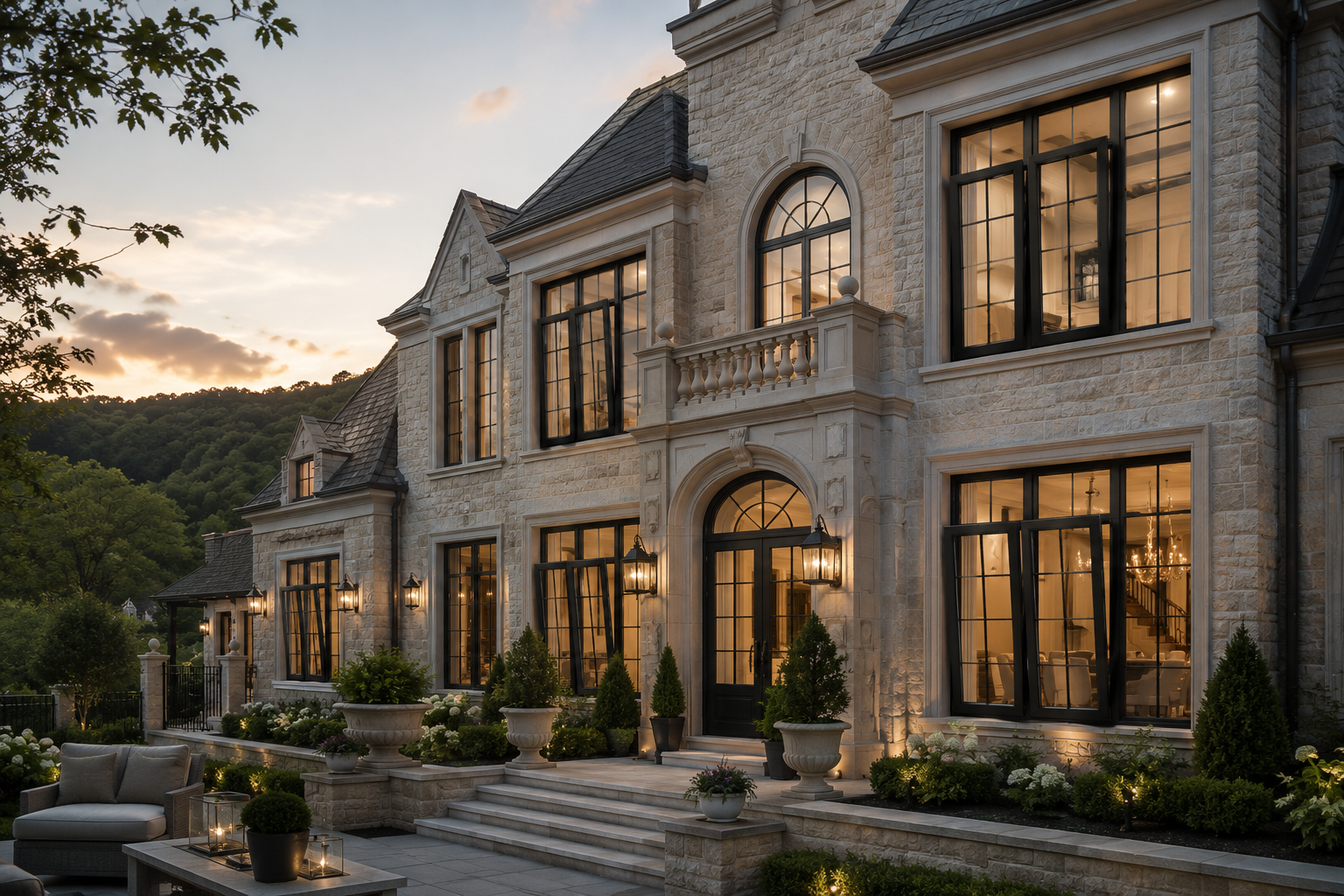
Properties in a designated historic district or under a landmark commission require approval before any exterior change. We confirm what is approvable on a specific property before order. Interior doors carry no commission requirement.
Period styles Crateworks builds for
Brownstone (NYC, Brooklyn, Boston, Philadelphia)
Brownstone restoration covers a tight set of period homes from the mid-1800s to early 1900s, almost all in urban East Coast settings. The defining window is a tall, narrow, multi-pane double-hung with a deep sash and a delicate muntin grid. Crateworks builds aluminum double-hung and casement units sized to the original openings, with simulated divided lites that match the historic muntin pattern. Frame color is typically deep bronze, anthracite, or RAL black to read consistent with the masonry.
Victorian
Victorian houses span roughly 1840 to 1900 and include Queen Anne, Italianate, Gothic Revival, and Second Empire subtypes. Windows are tall, narrow, often arched, with multi-pane upper sashes over single-pane lower sashes. Specialty shape windows are common, particularly arched and round, as gable accents. Crateworks builds the rectangular sashes in slim aluminum and the arched and round shapes through the {specialty shapes} hub.
Tudor and Tudor Revival
Tudor windows are casement windows with diamond or rectangular leaded-glass patterns set in a deep frame, often grouped in twos or threes under a stone or timber lintel. Crateworks builds aluminum casements with simulated divided lites in the Tudor pattern, and frame color can be specified to match the dark stained timber that anchors the elevation. The slim aluminum profile reads correctly at a distance and removes the maintenance cost of period wood.
Craftsman and Arts and Crafts
Craftsman bungalows from the 1900s to 1930s use a window pattern called divided light over single light: an upper sash with three to six vertical panes over a single-pane lower sash. The frame is sturdier than Victorian, with a wider sash horns. Crateworks builds aluminum double-hung windows with simulated divided lites in the Craftsman pattern. Bronze, dark green, and deep brown are the conventional finish colors.
Colonial and Colonial Revival
Colonial windows are double-hung with a symmetric multi-pane grid, typically six over six or eight over eight, set with shutters on either side. The grid pattern reads traditional from any distance. Crateworks builds aluminum double-hung windows with the Colonial grid, in any RAL color. White is the conventional finish for Colonial Revival, with deep green and black as the common alternatives.
Landmark and historic district properties
Properties in a designated historic district or under a landmark commission carry approval requirements before any window can be changed. The commission reviews the proposed window for material, profile, finish, glazing pattern, and operational style, and approves or rejects. Aluminum with simulated divided lites is increasingly accepted in landmark districts that previously required wood, particularly when the muntin profile and the frame depth match the historic precedent. We confirm what is approvable on a specific property before order.
Where we start: interior first
The simplest entry point on a period restoration is the interior. Period-appropriate glass partitions, sliding doors with divided-lite patterns, pocket doors with deep frames, and pivot doors all ship anywhere today, with no certification or commission process. The interior aluminum doors page covers the configurations we build. Exterior windows are confirmed against the local code and the landmark commission before order.
Specialty shapes for period gables and arches
Victorian, Italianate, and Gothic Revival properties carry arched, round, oval, and half-round windows on the gable ends and above doors. Crateworks builds these through the specialty shape windows hub, in matching profile and finish to the rectangular windows on the same elevation. Send the opening, an elevation drawing, and any reference for the muntin pattern.
Common questions
Send the period and the elevation.
Tell us the property type, the location, the openings, and any reference photos of the existing or original windows. We return a configuration that reads correctly for the period in aluminum.