- Barrel saunas heat fast and ship compact, but the curved wall trims usable floor and bench space compared to a cabin of the same footprint.
- The two failure points to inspect are the staved wall seams (where they meet the end panels) and the underside where the barrel meets the ground.
- Check wood grade, confirm the heated chamber is dowel-joined or interlocked rather than glued, and check the steel band hardware is corrosion-rated for your climate.
- Crateworks leads with cabin-style cedar saunas built to the space, but can source a well-built barrel sauna if that's the look you want, indoors or outdoors, cedar shell only, heater sourced separately from a name-brand line.
What a barrel sauna actually is.
A barrel sauna is exactly what it sounds like: a cylindrical cedar shell built from staves (long, tongue-and-groove boards) bent and held in a curve by steel bands, capped with flat end panels and usually a door on one end. It sits on two runners or a cradle rather than a full foundation, which is a big part of the appeal. It arrives mostly assembled or as a stave kit, gets set on a pad or gravel bed, and is ready for a heater far faster than a stick-built cabin.
The curve isn't decorative. It's structural. A round wall under tension from the steel bands is inherently strong and sheds rain and snow without a pitched roof doing the work. That's the whole engineering case for the shape, and it's a real one.
The trade-offs nobody puts in the brochure.
The curve that makes the barrel strong also eats usable space. A bench built against a curved wall loses headroom and legroom near the ends of the bench compared to a flat wall at the same footprint, so a barrel rated for four people typically feels tighter than a cabin rated for four. If you're sauna-ing solo or in pairs this rarely matters. If you want a real four-person bench layout, measure twice.
Staving and seams are the second thing to look at closely. A barrel wall is built from dozens of individual boards running the length of the cylinder, each one a seam. Done well, the tongue-and-groove joints are tight and the wood moves as a unit with humidity cycling. Done poorly, or with the wrong wood, those seams open up over a season or two and you get gaps at the joints.
The third trade-off is ground contact. A barrel sits low, often directly on runners a few inches off the ground, which is convenient to install but puts the lowest stave close to soil moisture, snowmelt, and splashback. Without a real gap and ventilation underneath, that's where rot starts first. This isn't a reason to avoid the format. It's a reason to ask exactly how the base is detailed before you buy.
What to check before you buy.
A few specific questions separate a barrel sauna that lasts fifteen years from one that needs stave replacement in five. Ask for these in writing, not as a verbal assurance.
Barrel vs. cabin: when each makes sense.
A barrel earns its keep when the goal is a compact, fast-to-heat, one-to-three-person setup with minimal site prep: a deck corner, a small backyard, a spot where you want something that looks finished the day it's placed. It's also a strong choice when budget favors a kit format over a built structure.
A cabin-style sauna earns its keep when you want a real four-to-six-person bench layout, a window, a change area, or a footprint that matches an existing outbuilding or interior room exactly. Flat walls also make future changes (adding a window, resizing a bench, running a vent path) more straightforward than cutting into a curved, staved wall.
Neither is the wrong answer. The format should follow the space and the group size, not the other way around.
How Crateworks sources it.
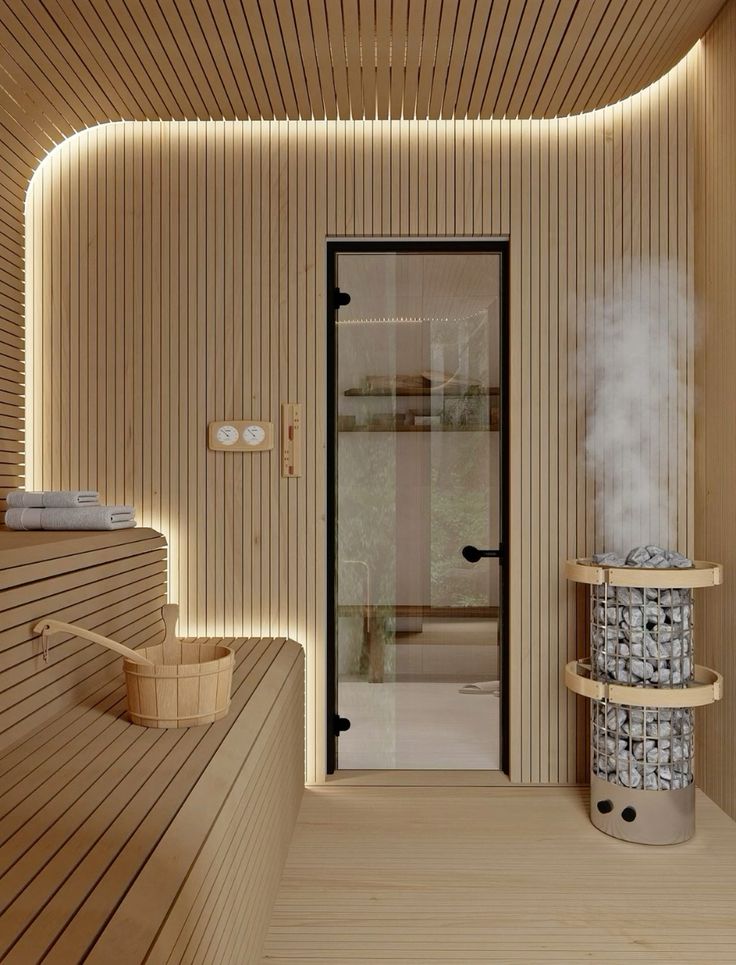
Crateworks leads with cabin-style cedar saunas because most projects we spec are sized to a specific space, indoors or outdoors, and a flat-walled build gives more control over bench layout and door placement. If a barrel is the look you're after, we can source a well-built one to the same standard: solid cedar grade, dowel-joined or interlocked chamber construction (no adhesive in the heated interior), and corrosion-rated band hardware for your climate.
In every case, the sauna package Crateworks sources is the cedar shell and structure. The heater is a name-brand unit, installed locally by a licensed electrical contractor. We don't do electrical work, and we don't recommend anyone skip that step regardless of who sells the sauna. Sauna and heat exposure carry real health considerations; this isn't medical advice, and anyone with a heart condition, pregnancy, or other health concern should check with a doctor before regular use.
What to check on any barrel sauna before you order, and why it matters.
| Check | What to look for | Why it matters |
|---|---|---|
| Wood grade | Clear or select cedar, minimal knots on interior-facing staves | Knots near the heat source can weep sap; clear grade holds up longer at sauna temperatures |
| Chamber construction | Tongue-and-groove or dowel-joined staves, no glue in the heated interior | Adhesives can off-gas when heated; a mechanically joined chamber also moves naturally with humidity |
| Band hardware | Stainless or coated steel bands rated for your climate | Bare or low-grade steel bands rust and loosen faster in coastal or humid climates, loosening the whole wall |
| Base and ground clearance | Runners or a cradle with real airflow gap underneath, not resting flat on soil | The lowest stave is the first place moisture collects; airflow underneath is what prevents rot there |
| Heater and clearance | Name-brand heater sized to the interior volume, clearances per the heater manufacturer's spec | Undersized or mis-cleared heaters run hot, wear faster, and are a safety issue; heater install is a licensed electrician's job, not the sauna supplier's |
Common questions.
- Is a barrel sauna as good as a cabin sauna?
- It depends on what you need. A barrel heats efficiently and installs with less site prep, but the curved wall trims usable bench space compared to a flat-walled cabin at the same footprint. For one to three people, a barrel is a strong choice. For a full four-to-six-person layout, a cabin usually fits the group better.
- Does a barrel sauna need a foundation?
- Not a full foundation, but it does need a proper base: a level pad, gravel bed, or runner system with real air gap underneath. Setting a barrel directly on soil or a flat slab with no ventilation underneath is the fastest way to get moisture damage at the lowest stave.
- What wood should a barrel sauna be made from?
- Cedar is the standard for a reason: it's naturally rot- and insect-resistant and stable through heat and humidity cycling. Within cedar, ask about the grade. Clear or select grade with minimal knots on the interior-facing staves holds up better at sauna temperatures than lower grades.
- Do the seams between staves eventually open up?
- They can, if the chamber is glued rather than mechanically joined, or if the wood grade is inconsistent. A well-built barrel uses tongue-and-groove or dowel-jointed staves with no adhesive in the heated interior, which lets the wood move as a unit rather than opening gaps at individual seams.
- Can Crateworks supply the heater with the barrel sauna?
- Crateworks sources the cedar shell and structure. The heater is a name-brand unit sourced alongside it, and installation is handled locally by a licensed electrical contractor. We don't perform electrical work ourselves, on a barrel or a cabin build.
Keep reading.
Building a sauna, barrel or cabin
Crateworks specs cedar saunas to the space, indoor or outdoor, from a flat-packed cabin kit up to a full coordinated package. Tell us the footprint and we'll tell you what fits.