- Wine kept for years wants 50 to 60°F, held steady within 2 to 3°F; bottles opened within a few weeks are fine at 75°F or below.
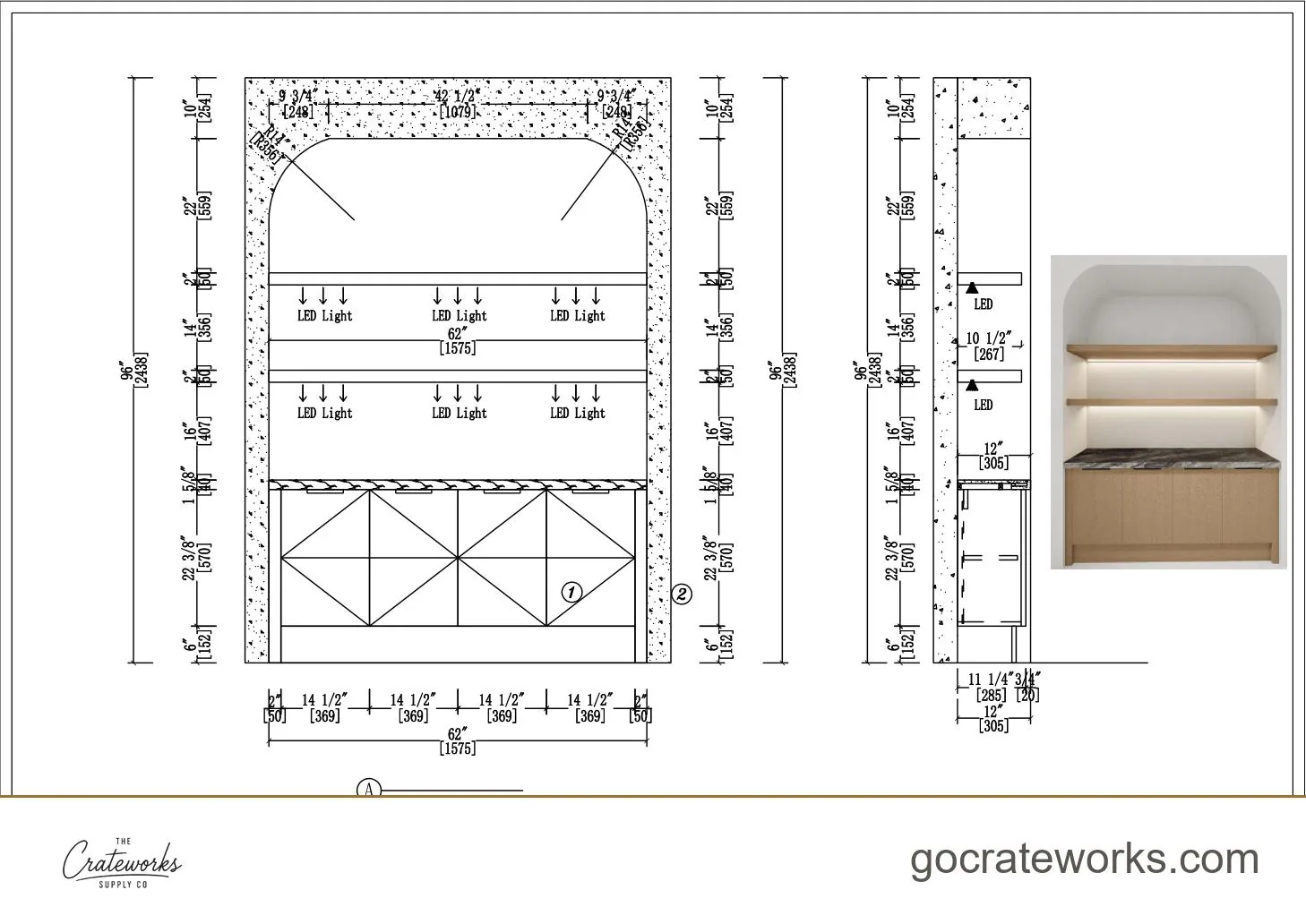
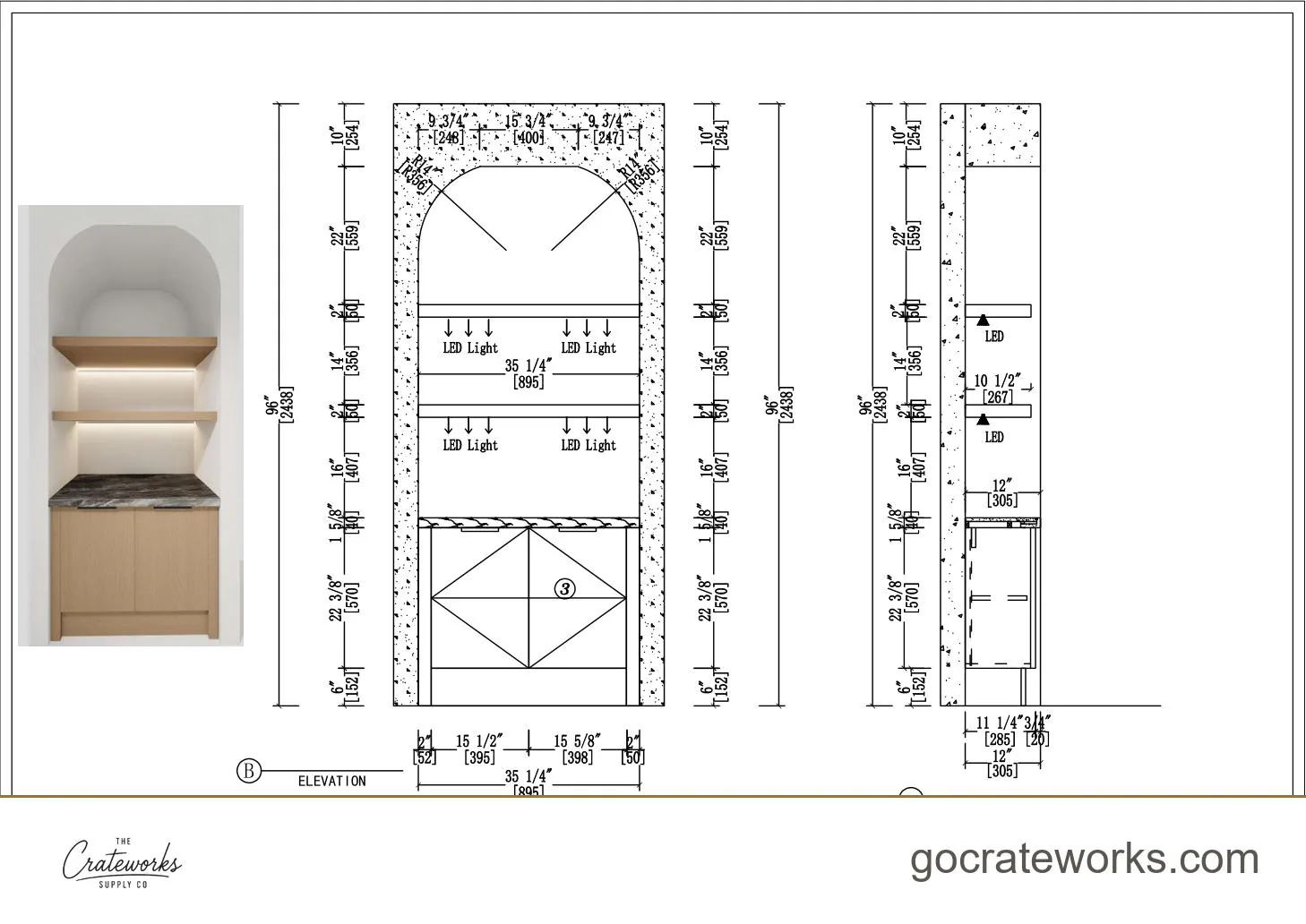
- A small wine room can be a niche: the bar niche we drew is 35 1/4 inches wide and 96 inches tall, with two lit 10 1/2-inch shelves over a stone counter.
- An enclosed wine room under the stairs with a door needs 1/2-inch gypsum board on the enclosed side under the 2021 International Residential Code.
- Racks, glass-door cabinets and lit shelves are drawn to your measurements and arrive in about 90 days, delivered.
Show or store: what is the first decision?
Decide whether the room shows bottles or keeps them. Purdue Extension's wine storage guide puts long-term storage at 50 to 60°F, around 55°F for a traditional cellar, held steady within 2 to 3°F. It treats 75°F or below as fine for one to four weeks and anything at 86°F or above as off limits, even briefly.
So a display wall in a living room holds the bottles you will open soon, and a cooled room holds the ones you are ageing. Store corked bottles on their side and keep them out of direct sunlight. Cooling is a separate item from the cabinets and racks.
What are good small wine room ideas?
A niche. The whole-home build we drew has two arched bar niches, 62 and 35 1/4 inches wide and 96 inches tall, each with two 10 1/2-inch-deep shelves lit from underneath, over a 12-inch-deep base cabinet and a 1 5/8-inch stone counter. They are bars, not cellars, and they show how much fits in a shallow wall.
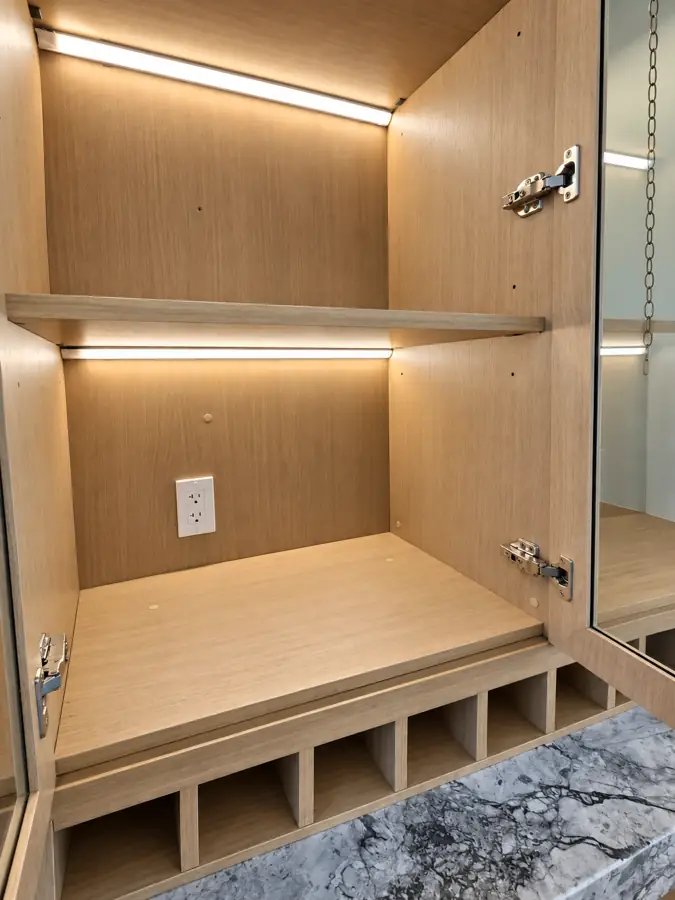
A cabinet row. The coffee bar in the same house carries a row of bottle cubbies 4 1/2 inches high under a glass-front upper, inside a 57-inch niche. From our standard range, a wall wine rack cabinet is 30 inches wide, 18 high and 12 deep, and a wine glass holder is 30 by 1 1/2 by 12.
Can you build a wine room under the stairs?
Check the code first, then measure. The space under a stair is a tall triangle, so measure the height at several points along the slope before planning racks or a door.
If the space is enclosed and has a door or access panel, section R302.7 of the 2021 International Residential Code calls for 1/2-inch gypsum board on the enclosed side of the walls, the underside of the stair and any soffits. Ask your building department which edition applies where you build.
What does a glass wine room need?
A frame, glass doors and a place out of the sun. Our glass-door wine cabinets and walls use a stainless frame with foam insulation, glass doors and oak bottle rests, built to your length, width and height, with brushed finishes such as gold or rose gold and interiors in oak, acrylic or leather.
For a room rather than a wall, there is a walk-in cellar fit-out lined with lit racks, or a round glass room that stands in the middle of the space. If bottles will age in it, plan for long-term storage at 50 to 60°F.
Where does wine room design start?
With the wall and a bottle count. Measure the wall or room, count the bottles you keep and the ones you show, then pick the pieces: racks, glass-door cabinets, lit shelves and a counter. A timber rack wall we build runs 169 inches wide, 96 tall and 15 deep, in clear alder, painted grey or sand ash wood grain.
Then it gets drawn to your measurements, every piece on one quote. See the wine cellars and bar cabinets we build and the built-ins from the same house.
Wine room numbers: storage temperatures from Purdue Extension, the code line for under-stair rooms, and the sizes of pieces we have drawn.
| Item | Inches or °F | mm or °C | Where it comes from |
|---|---|---|---|
| Long-term storage temperature | 50 to 60°F | 10 to 16°C | Purdue Extension |
| Traditional cellar temperature | About 55°F | About 13°C | Purdue Extension |
| Hold the temperature within | 2 to 3°F | 1 to 1.5°C | Purdue Extension |
| One to four weeks | 75°F or below | 24°C or below | Purdue Extension |
| Never, even briefly | 86°F or above | 30°C or above | Purdue Extension |
| Wide bar niche we drew | 62 W x 96 H | 1575 x 2438 | Our drawing |
| Narrow bar niche we drew | 35 1/4 W x 96 H | 895 x 2438 | Our drawing |
| Lit shelf depth | 10 1/2 | 267 | Our drawing |
| Base cabinet depth in the niche | 12 | 305 | Our drawing |
| Wall wine rack cabinet | 30 W x 18 H x 12 D | 762 x 457 x 305 | Our standard cabinet range |
| Wine glass holder | 30 W x 1 1/2 H x 12 D | 762 x 38 x 305 | Our standard cabinet range |
| Timber wine rack wall | 169 W x 96 H x 15 D | 4293 x 2438 x 381 | Built to order |
| Under-stair lining, enclosed room | 1/2 (gypsum board) | 12.7 | 2021 International Residential Code R302.7 |
Common questions.
- What are good small wine room ideas?
- Use a niche, a wall or a cabinet row instead of a room. A lit niche 35 to 62 inches wide holds shelves over a counter; a wall wine rack cabinet is 30 inches wide and 18 high; bottle cubbies fit under a glass-front upper. Keep it out of direct sunlight.
- What temperature should a wine room be?
- 50 to 60°F for wine kept for years, around 55°F in a traditional cellar, held steady within 2 to 3°F, per Purdue Extension. Bottles you open within a few weeks are fine at 75°F or below. Never let any wine reach 86°F.
- Can you build a wine room under stairs?
- If the space is enclosed with a door, the 2021 International Residential Code calls for 1/2-inch gypsum board on the enclosed side. Check which edition your building department uses, and measure the height at several points along the slope before planning racks or a door.
- Does a glass wine room need cooling?
- Only if bottles will age in it. Long-term storage wants 50 to 60°F, held steady; if the room cannot hold that on its own, it needs cooling. Cooling is a separate item from the cabinets and racks.
- How should bottles be stored in a wine room?
- On their side, or upside down, if they have corks, which cuts the air exchange through the cork, per Purdue Extension. Keep them out of direct sunlight and away from temperature swings, which test the closure.
Sources.
For the rest of the room
Keep reading.
Planning a wine room?
Send a photo and the measurements of the wall or room. We draw the racks, cabinets and lighting to fit and quote every piece on its own line in 5 to 7 business days. Lead time is about 90 days, delivered.